

Table of contents
And that is where things get wonky when people try to force both into the same bucket. This article straightens all of that out. You will get a real-world take on how each one actually behaves in day-to-day work and why they create completely different kinds of value.
What Is Agentic AI?

Agentic AI represents a type of artificial intelligence that can take actions on its own to reach a goal. You give it an objective, and it breaks that objective into steps, makes decisions, and executes those steps with minimal human intervention.
Key Components Of Agentic AI:
- Goal Definition: A clear target that the system works toward, either set by a human or generated by the agent itself.
- Environment Awareness: Inputs, context, system states, and external data the agent uses to understand what is happening.
- Planning System: A reasoning engine that breaks a goal into steps, chooses strategies, and sequences repetitive tasks.
- Action Execution Layer: Tools and agentic AI capabilities to perform actions in the real or digital environment.
- Feedback & Evaluation Mechanism: Mechanisms that let the system check outcomes, compare them with goals, and adjust next actions.
- Memory & State Tracking: Short-term and long-term storage that helps the agent learn from past steps and maintain continuity.
- Safety & Control Mechanisms: Rules and boundaries that restrict allowed actions and prevent harmful behavior.
4 Real-World Examples Of Agentic AI
Implementing agentic AI makes way more sense when you look at how it behaves in the wild. These 4 examples show you exactly how it works when it is dropped into real businesses with real problems.
1. CodaPet – Automating Sensitive Scheduling Without Dropping The Human Touch

CodaPet handles at-home pet euthanasia, which is one of the most sensitive services anyone could request. Their agentic AI is quietly coordinating the logistics on the back end. When someone submits an inquiry, the AI:
- Checks available vets in that ZIP code
- Filters them by specialty and time windows
- Sends the right appointment options automatically
If a vet marks themselves unavailable last minute, the AI recalculates alternatives on the fly instead of dumping the job back on a human. It even flags emotionally heavy messages so the on-call support person gets a heads-up before responding.
This is the type of job where speed matters, but empathy matters more – and the AI keeps everything moving smoothly here.
2. John Campbell – Using Agentic AI To Pre-Qualify Leads Before Calling Them

John is a Hilton Head real estate agent, and his AI doesn’t write listings or draft posts. It behaves more like a personal assistant. When someone browses a listing, the system:
- Tracks how long they linger on specific features
- Checks their local IP or relocation pattern
- Automatically pulls recent comps to determine whether this person is a casual looker or a serious mover.
If they are serious, the AI runs a quick “property-fit” pass – golf community preference, HOA tolerance, budget ranges from past behavior, and whether they are likely downsizing or moving up.
Then it hands John a clean, color-coded summary so he knows exactly how to approach the call. It is not glamorous – but it saves him from wasting two hours a day on leads that never go anywhere.
3. Pergola Kits USA – Agentic AI Handling Complex Custom-Order Validation

Pergola Kits USA gets tons of requests from homeowners who want custom patio structures. The back-and-forth is usually a nightmare: wrong measurements, incompatible add-ons, shipping limitations, zoning concerns. Their agentic AI system handles these complex tasks automatically. When a customer designs a pergola on the site, the AI checks:
- The dimensions against structural constraints
- Local wind-load requirements
- Which freight carriers can handle the weight for that region
If something won’t work, it doesn’t just block the order – it offers the nearest viable configuration and recalculates pricing instantly. Once approved, the AI generates a build sheet for the production team and verifies the customer’s installation environment to avoid incorrect anchors.
The ripple effect is simple – it quietly helps streamline your business processes by removing the back-and-forth that normally wastes hours. This is operational intelligence, not “chatbot intelligence.”
4. TimeBee – Using Agentic AI To Clean Up Employee Time Misreporting
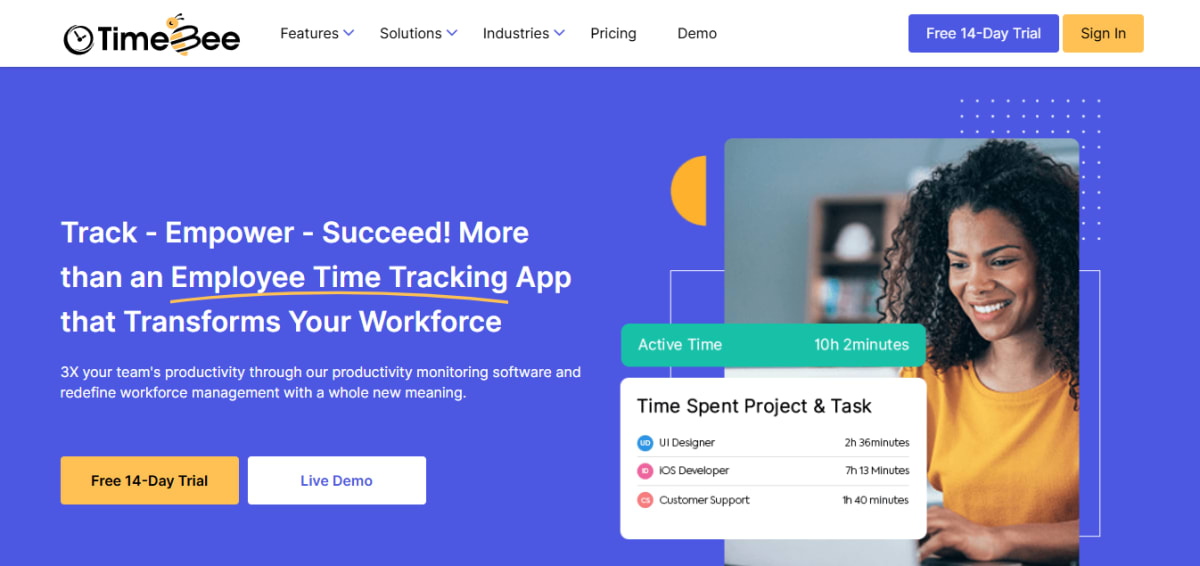
TimeBee is already great at tracking how teams actually spend their workday, but the part that drove their customers crazy wasn’t the tracking itself – it was the messy data that got into reports.
Someone would forget to stop a timer before lunch. Someone else would switch tasks mid-call but never log it. A few people were bouncing between apps so fast that their timesheets looked like static. The data wasn’t wrong on purpose; it was just human.
Instead of adding more reminders or pop-ups, TimeBee rolled out an agentic AI system whose entire job was to keep the time data clean. It watched activity patterns, keyboard pulses, app switches, idle streaks, and meeting attendance in real time. When something didn’t add up, the AI didn’t ask the user to fix it. It fixed it itself.
If someone joined a meeting late, the AI adjusted the meeting duration on the timesheet. If a timer kept running while the person was browsing unrelated tabs, the AI split the session into two clean blocks and labeled them properly.
And when it spotted an activity that didn’t match any existing task, it created a draft task and slotted it into the timeline so the person didn’t have to reconstruct their morning manually.
The best part was the way it handled days with a lot of small switches. Humans can’t track micro-context changes – but the agentic system could. It stitched the entire day into a timeline that actually matched how the person worked, not how the person meant to log it.
Managers stopped getting those puzzling reports with 48 “miscellaneous” entries. Employees stopped spending Friday afternoons cleaning up their week. And everyone stopped arguing about whether the data was accurate.
What Is Generative AI?

Generative AI is a type of AI designed to create new content. It relies on machine learning to identify patterns across massive datasets and produces text, images, videos, code, or audio based on what it has learned from training data. It doesn’t take autonomous action. It responds to your input and generates an output that matches the prompt.
Key Components Of Generative AI:
- Training Data: Large datasets used to learn patterns and relationships.
- Model Architecture: Neural network design (e.g., transformers, diffusion models) that determines how the system learns and generates.
- Tokenization & Encoding: Methods for converting inputs (text, images, audio) into numerical representations.
- Latent Space: A compressed internal knowledge space where the model maps concepts and relationships.
- Generative Engine: The part of the model that predicts and produces new content.
- Decoding & Output Formatting: Processes that convert numerical model predictions back into readable or viewable outputs.
- Safety & Alignment Filters: Layers that check outputs for accuracy, relevance, bias, or harmful content before returning them.
4 Real-World Examples Of Generative AI
Let’s look at a few examples where generative AI is turning complex processes into something people can actually use.
1. Re Cost Seg – Turning Dense Tax Rules Into Plain-English Reports

Cost segregation is confusing even for accountants. Re Cost Seg uses generative AI to break down property depreciation rules in a way normal humans can understand. Their gen AI tools take raw property data and turn it into a clean and digestible report that explains why certain parts of a home qualify for accelerated depreciation.
The generative AI:
- Rewrites IRS technicalities into conversational summaries
- Generates visual breakdowns
- Produces comparison scenarios showing the exact year-by-year tax impact
Nothing here requires taking action inside a system – it is all about translating technical complexity into human clarity. And because this is AI-generated content shaped around reality, it seems personal instead of robotic.
2. BusinessForSale – Drafting Listing Descriptions That Actually Sound Like The Business Owner

When someone wants to sell their business, the hardest part is writing a listing that sounds real, not corporate.
BusinessForSale uses generative AI tools to create seller-specific descriptions based on a quick intake questionnaire. If the owner runs a small café, the AI pulls the personality into the copy – the morning rush, the regulars who order the same thing every day, the reason the owner is moving on.
If it is an HVAC company, the AI highlights contract value, service radius, maintenance revenue, and employee certifications. It is storytelling wrapped around financial detail, crafted in the owner’s tone. This helps optimize the sales process and reduce the confusion buyers usually face, because they finally understand what they are looking at.
3. Pathfinder Law – Generating Case Explanation Summaries For Clients

Legal clients panic because they rarely understand what is happening in their own case.
Pathfinder Law uses generative AI models to create plain-language summaries after each major update. The AI reads through filings, notes from the lawyer, and reference documents, then produces a clean rundown:
- What happened
- What it means
- What is the next milestone
- What the client should prepare for
It also rewrites legal steps into everyday language – no legalese, no intimidation. The lawyer reviews it and sends it off. Instead of loading up clients in PDF documents, they get clarity in two paragraphs.
4. Start in Wyoming – Creating Filing-Ready Business Formation Guides

People starting a business in Wyoming always get stuck at the same point: figuring out what to file and which state requirements actually apply to them.
Start in Wyoming saw this pattern over and over – founders moving between 5 government websites and sending long emails just to understand basic steps.
So they used generative AI to turn all that confusion into something instantly useful.
They fed the AI real user questions, state instructions, local permit templates, and their own internal notes from years of helping new founders. The model started producing custom formation guides based on the entrepreneur’s business type. A coffee trailer owner got a totally different plan than someone creating an online tutoring service. Each guide included:
- A personalized checklist of state, county, and city filings
- Short explanations of why each item mattered
- Links to the exact forms needed
- A simple timeline that matched how fast the founder wanted to launch
They also added a little feature founders loved: a “What You’ll Need Ready” section. It was a quick snapshot of documents and IDs they should have on hand before even starting the process. The AI pulled this together automatically based on the business model.
Whenever Wyoming updated a rule, Start in Wyoming pasted the new text into their system, and the AI instantly regenerated updated guides.
Founders finally got a clear path, and Start in Wyoming stopped wasting hours rewriting the same explanations – all thanks to one very practical generative AI workflow.
Agentic AI Vs Generative AI: 6 Core Differences You Need To Know
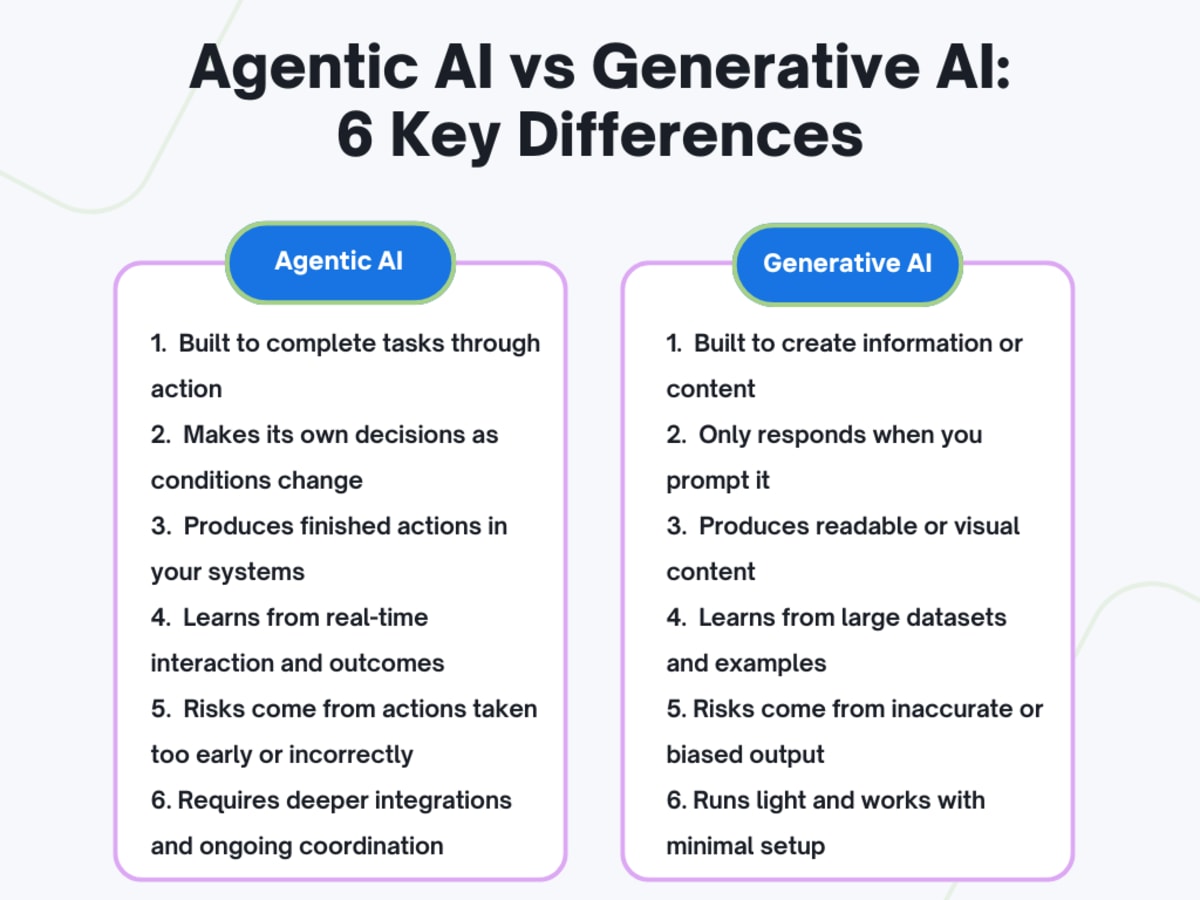
You can’t really pick between agentic AI and generative AI until you see how differently they operate once you put them to work. These 6 key differences break it down in a way that makes choosing between them feel a whole lot clearer.
1. Purpose & Primary Function
Agentic AI
Unlike traditional AI that needs constant human intervention, agentic AI is built to handle work that unfolds over time. Its whole purpose is to pick something up and keep going without involving you back in. It doesn’t care about making something pretty. It cares about finishing what it started.
Agentic AI holds onto context, keeps track of where it is, and deals with whatever shows up next. If the task bends, it bends with it. If something breaks, it figures out how to get around it. Its purpose is momentum.
Generative AI
Generative AI is the system you use when you need clarity, not momentum. Many generative AI systems today are built on Large Language Models (LLMs), so they give shape to whatever you are thinking about.
When information is complex, it makes it readable. When ideas are a bit loose, it mimics human creativity to finish the thought. When you need something rewritten, simplified, expanded, or fully created from scratch, it does it with ease. It is not trying to “get things done.” It is helping you understand or explore.
How To Pick The Correct Approach
Pinpoint the moment where the work drains your energy.
- If the drain comes from babysitting steps, you are looking at an agentic problem.
- If the drain comes from figuring out what to write or how to organize thoughts, that is generative.
Look at how the task behaves when you walk away.
- If it flat-out stops because no one is pushing it forward, it needs an agent.
- If nothing breaks and you simply lose human creativity, generative fits.
Check whether the outcome depends on progress or expression.
- Progress → agentic.
- Expression → generative.
Ask yourself what you would notice first if the system worked perfectly.
- A finished task? → agentic.
- Clear information? → generative.
2. Level Of Autonomy & Decision-Making
Agentic AI
Unlike generative AI, Agentic AI handles the parts of work where someone normally has to keep making small judgment calls. It notices when something changes and updates its plan to keep moving without waiting for you to tell it what the new plan should be.
It is not dramatic about it – it just handles the decisions no one wants to hover over. You give it direction once, and it handles the rest.
Generative AI
Gen AI models don’t step into decision-making at all. It reacts to the moment you are in. Whatever prompt you are thinking through, it helps you express it. It doesn’t wander ahead. It doesn’t check what is happening in the environment. Generative AI focuses on staying right where you are and helps you firm up the current thought without assuming the next one.
How To Pick The Correct Approach
Replay the task in your head and mark every moment a choice is made.
- More choices than content? → agentic system.
- More content than choices? → generative system.
Check whether decisions depend on something changing in real time.
- If the next step depends on what the system finds, agentic is your match.
Look for moments where someone normally says, “Okay, now do this instead.”
- If these moments exist, AI-powered agents handle them for you.
- If the task never shifts based on conditions, generative stays cleaner.
Ask yourself who currently holds the responsibility to “keep things moving.”
- If it is you → agentic AI is built for exactly that.
- If nothing needs to be “moved,” and it is more about polishing info with minimal human input, stick with generative.
3. Output Type & Nature
Agentic AI
Agentic AI solutions give you outcomes you don’t read – you notice them. Suddenly, the dataset is organized. The folders are sorted. The tickets are updated. The message is sent. The research is compiled. Its output is not a piece of content. Its output is a completed change in the world.
Generative AI
Generative AI creates and then gives you material that you immediately interact with. A paragraph. A summary. A set of ideas. A polished explanation. It is something you can read, tweak, revise, or hand to someone else. The value is in the clarity of what it creates, not in any action it triggers.
How To Pick The Correct Approach
Describe “done” without mentioning the process.
- If the sentence describes a change that happened (e.g., “The files are categorized”), pick agentic.
- If it describes information you can read, pick generative.
Decide whether the output will exist inside a tool or inside your mind.
- Inside a tool → agentic AI works.
- Inside your thought process → generative.
Check whether the output is a trigger or a reference.
- Trigger (something happens next) → agentic.
- Reference (something is read next) → generative.
Examine whether quality improves through doing or explaining.
- Doing → agentic.
- Explaining → generative.
4. Learning Mechanism & Adaptability
Agentic AI
Agentic AI technology learns the same way you figure out how to handle a messy task at work – by doing it, messing up a little, fixing the mess, and getting sharper the next round.
It pays attention to friction points inside the workflow. If it sends something to the wrong tool or gets an unexpected response, it adjusts its next steps rather than forcing the same script again. The learning is “situational,” almost like it is forming its own muscle memory around the job you give it.
Generative AI
Generative AI learns from exposure, not experience. It improves by absorbing many examples and reorganizing the patterns internally. When it adapts, it is not because of something that happened in your system – it is because you fed it better instructions or cleaner examples. It becomes sharper in expression, not execution.
How To Pick The Correct Approach
Check if the task needs live feedback.
- If what actually counts is real results – not just good-looking output – you are in agentic territory.
Look at how often the task changes.
- Frequent rule or workflow changes mean you need an AI agent that adapts through interaction, not a model stuck in its training patterns.
Ask yourself what the AI is “learning” from.
- If it must learn from responses or system behavior → agentic.
- If it just needs text patterns → generative AI excels here.
5. Risk & Ethical Implications
Agentic AI
Agentic AI creates risk through actions, not content creation. The danger is in the system acting at the wrong time, acting too early, acting without enough context, or accessing something it shouldn’t. The ethical weight sits in control – who gives the AI permission, who supervises the actions, and how tightly you fence the boundaries.
Generative AI
Generative risk is inside the output. Not because it will push a button, but because it may produce something flawed that looks correct. You deal with tone, misrepresentation, training bias, privacy errors, and outputs that might mislead someone reading them. The trouble isn’t “action,” it is “influence.”
How To Pick The Correct Approach
Trace the worst-case scenario.
- If the worst case is “wrong message or biased content,” generative is fine.
- If the worst case is “the AI acted when it shouldn’t have,” you need agentic safeguards.
Look at permission levels.
- If the task requires touching real systems, treat it as agentic and design around strict boundaries.
Decide if human oversight is mandatory.
- If yes, generative works well.
- If not, and the system must act independently without constant human input, this is squarely agentic and needs far more governance.
6. Resource Requirements & Technical Complexity
Agentic AI
Agentic AI eats resources because it lives inside your operations. It needs careful software development, pathways to your tools, a memory of what happened before, guardrails, triggers, and a place to store decisions.
You are building a small operational brain that coordinates things – which means more engineering and more ongoing care. Not complicated in the theoretical sense, just heavier in the “please don’t break production” sense.
Generative AI
Generative systems are lightweight unless you intentionally add layers. You can pair a model with a prompt and get something functional in minutes. Complexity only appears when you strap on custom instructions or evaluation layers – but the foundation itself is clean and easy to maintain.
How To Pick The Correct Approach
Map the operational footprint.
- Many interconnected steps → agentic.
- One output per request → generative.
Count the integrations.
- One system → generative is usually enough.
- Several systems → you are drifting into agentic territory.
Check maintenance expectations.
- If you want something that mostly “just runs,” generative is simpler.
- If you want something that adapts and reacts, expect agentic overhead.
Conclusion
When it comes to agentic AI vs generative AI, the choice isn’t about picking the “better” one. It is about picking the one that actually solves the problem in front of you. Trying to use generative AI like an agent just slows everything down, and expecting an agent to create genius content is a recipe for frustration. So, treat the tools like what they are, not what you wish they were.
At Smartsupp, we have built a system that blends the best of both worlds. We give your team the power to chat live, automate common questions with chatbot flows, and let our AI‑powered Shopping Assistant handle customer needs when agents are busy or offline.
All of these plug directly into your website in minutes. You get visitor context, chat history, and a customizable widget that fits your brand. Sign up for free now and give your business a smarter way to talk to people.