Automatic messages – all the secrets revealed

)
Automatic messages (or triggers) are an automated feature that helps agents start a conversation with a visitor. They let you reach out to a potential customer at the right moment and steer them towards a conversion. We have described how to set them up and when to use them in this short article.
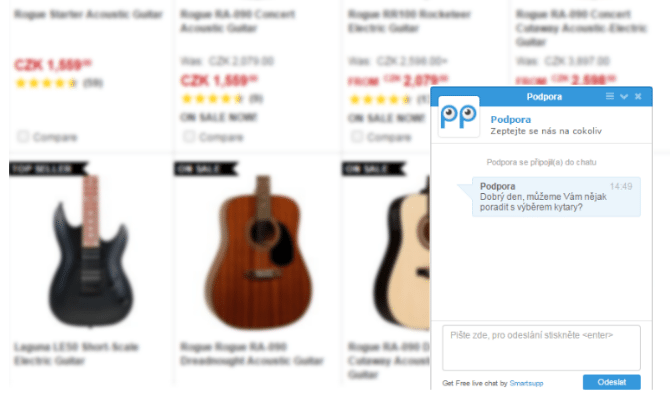
Let us say a visitor returns to a particular page of your musical instrument store. They have been here before, they have picked a few favourites, but they are not sure which guitar to choose. That is exactly the moment to let them know that you are ready to help. Thanks to automatic messages you do not have to watch the movement of every undecided customer – you just set the conditions under which a visitor should be approached, and the moment they are met, a chat window appears offering help.
Why use automatic messages
More conversions
Customers on the internet like their comfort. They would like to know more details about the goods they picked, but if you do not have them on the page, they will not feel like hunting for your email address and waiting 3 days for an answer. It is more comfortable to find the goods on another site, perhaps a competitor's. With automatic messages you can meet them halfway. Just set up personalised messages for the most frequent scenarios and test what visitors respond to most. Once you are in touch with them, your chances of closing the deal are considerably higher.
More conversions with a higher value
The experience of our users shows that visitors who use the chat on their website buy up to 5 times more often than the average visitor. These people also spend 12 times more time on the site than the average visitor and spend 30 % more than the average customer. Worth considering, is it not?
Higher customer satisfaction
If you help your customers at the right moment, you make the whole buying process considerably simpler and more pleasant for them.
How to set up an automatic message
Setting up an automatic message is a fairly simple process. Let us start by creating a new one.
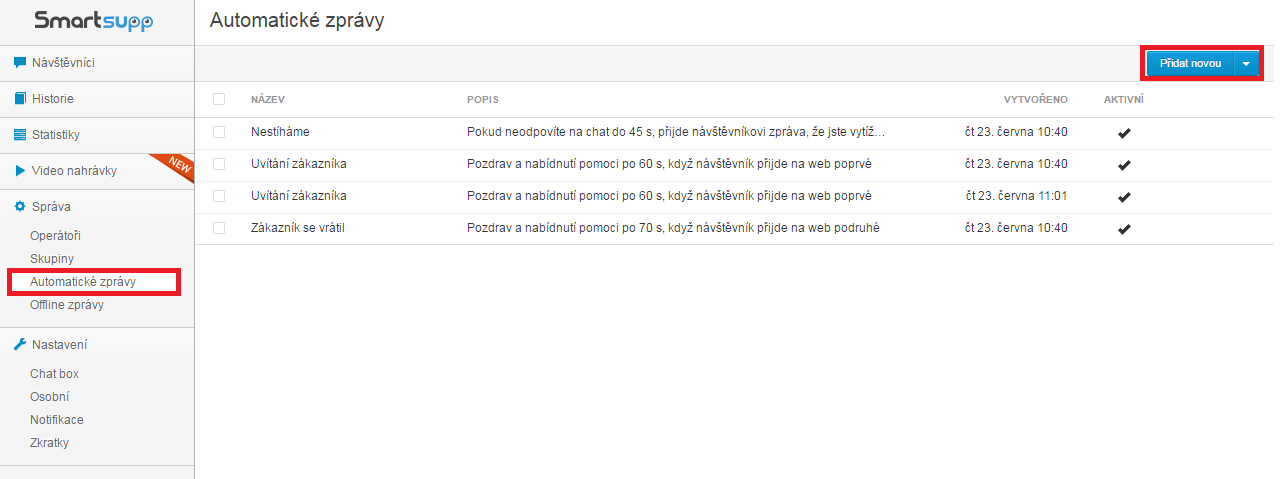
Then you need to enter a name and a description for the message, which will help you find your way among them. Smartsupp offers three options for triggering a message:
When the chat is displayed on the site
When the visitor writes a message in the chat
When the visitor clicks on the chat
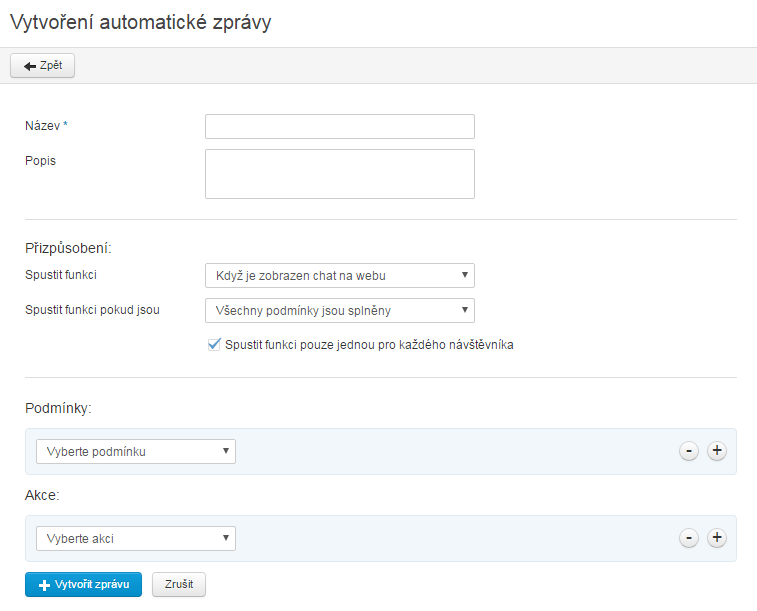
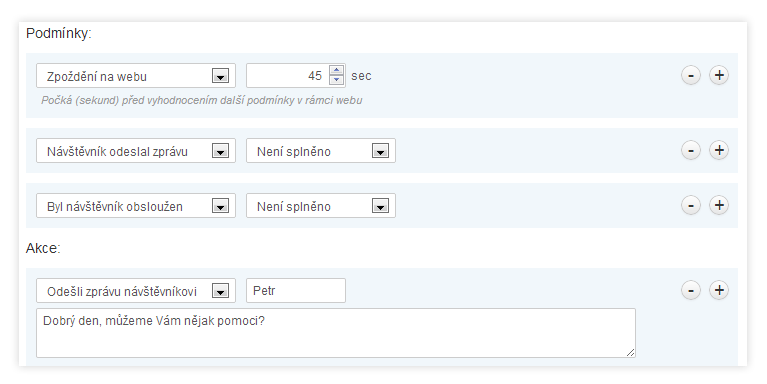
To send the message you also have to set the conditions under which it triggers. You can choose from metrics such as the visitor's behaviour on the page, their geographic location, the page currently displayed, previous conversations and so on.
Best practices
Now you know how to set automatic messages up. So let us look at the cases where you can use them and at what such messages could look like.
A returning visitor
With visitors who come back to your site you can assume a greater interest in what you offer, which also raises the chance of a successful conversation on chat. All you have to do is set up an automatic message based on the number of visits, the number of pages viewed and the time spent on the page.
An example message:
Hello and welcome back to our site. Is there anything we can help you with today?
Too many visitors at once
Sometimes you may find that there are more visitors asking questions than your agents can handle. In that moment it makes sense to let them know that they will have to wait a while. For that it is enough to set the message based on two options: the visitor sent a message, and the visitor was served.
An example message:
Hello. Unfortunately all our agents are fully occupied at the moment. If you do not want to wait, send us your email and we will get back to you. Thank you for your understanding.
A conversation with a foreign visitor
Imagine your site targets visitors from France and Germany. Because you want to avoid misunderstandings, you insist that visitors from Germany are served in German. For that it is enough to set the trigger based on Location / Country. On top of that you can use the "Groups" feature, which will automatically route visitors from Germany to your German-speaking agent.
An example message:
Hallo! Kann ich Ihnen helfen?
An opportunity for cross-selling
Let us say your customer wants to buy a guitar. In that case an electronic tuner and a strap may come in handy as well. If they buy them together, they save 200 crowns. To point them to this offer, set the message using the URL of the page with that guitar and the time spent on the page.
An example message:
Hello, this is Lucka. I would like to point you to our current offer. If you buy the TOLEDO guitar together with an electronic tuner and a strap, you save 200 crowns. Would this set interest you?
Help with filling in a form
Your visitor wants to register for your Premium Musical Club but has got stuck on the form page. They may have stepped away, but it is also possible that they are having technical trouble. To set the message it is enough to use the time spent on the page and the URL of the form page.
An example message:
Hello, this is Patrik. Can I help you with anything?
Help with getting through the basket
It happens that the delivery conditions are not entirely clear to the customer, or that the buying process is too complicated. Similarly to the previous case, it is enough to set the message based on the time spent on the page and the URL of the basket.
An example message:
Hello. Thank you for visiting our site. Can we help you in any way with completing your order?
Quality comes before quantity
As you have probably worked out yourself by now, automatic messages can be a very useful feature in your chat. Even so, it is worth mentioning that less is sometimes more. For example:
First of all, give your visitors enough time to look around your site. There is no need to bother them with a prepared message right at the start of their visit. It is rather like a shop assistant walking up to you in the doorway.
Be careful with the number of automatic messages as well. They should not trigger on every page of your site. (Fortunately you can also set a condition that a visitor does not receive more than one automatic message.)
Try to avoid robotic communication. Your visitors want to feel that the message came from a real person and not from an automated bot.
Always measure everything. That is how you find out what works for you and what does not. Test and improve your messages and their settings. Your visitors will appreciate the effort.